The Golden Rule Store
The Hubbub (505 N Tower) & Hubcap Art Park (501/503 N Tower)
by Kerry Serl, 2025
HISTORY
The Hubbub property was originally part of the James C. Cochran’s Donation Land Claim: 640 acres claimed by Cochran on behalf of his black foster son, George Washington. George Washington, was born in Virginia in 1817 to a white woman and a slave father. His mother begged her friends, James and Anna Cochran to take George out of Virginia to protect him from slavery. They moved with Washington to Ohio, Missouri, and in 1850 to the Oregon Territory. Washington scouted from the Cowlitz to Puget Sound for an agreeable location and in 1852 built a cabin next to the sources of commerce in the area: the Chehalis River, the Cowlitz Trail, and the Military Road. Travelers along the trails would often stay at his cabin overnight. One night, Washington overheard some guests saying that since a black man could not own property in Oregon Territory, they planned to jump his claim. That day, George walked 25 miles to Cowlitz Landing, now south Toledo, to ask his foster parents for a great favor: Could they make a donation land claim around his cabin? James Cochran obliged his son and rode to Olympia to make a claim. James and Anna had to live on the property to satisfy the homesteading rules, which was advantageous to them too as Washington could care for them in their old age. When they met the claim requirements, they sold the property to Washington.
Washington married recently divorced Mary Jane Coonness in 1868. Four years later when the North Pacific Railroad announced plans to bring the railroad through Washington’s property, commerce shifted to the east side of his property; the Washingtons saw the opportunity to build a town, originally called Centerville.
Perhaps in order to raise capital to create the infrastructure of his town, Washington sold this property and 40 acres around it to Josephine Townsend in 1872.
By 1889 Washington had developed Centralia south of Maple Street, and the Railroad Addition was developed north of First Street. There was no connection of streets between the two areas.
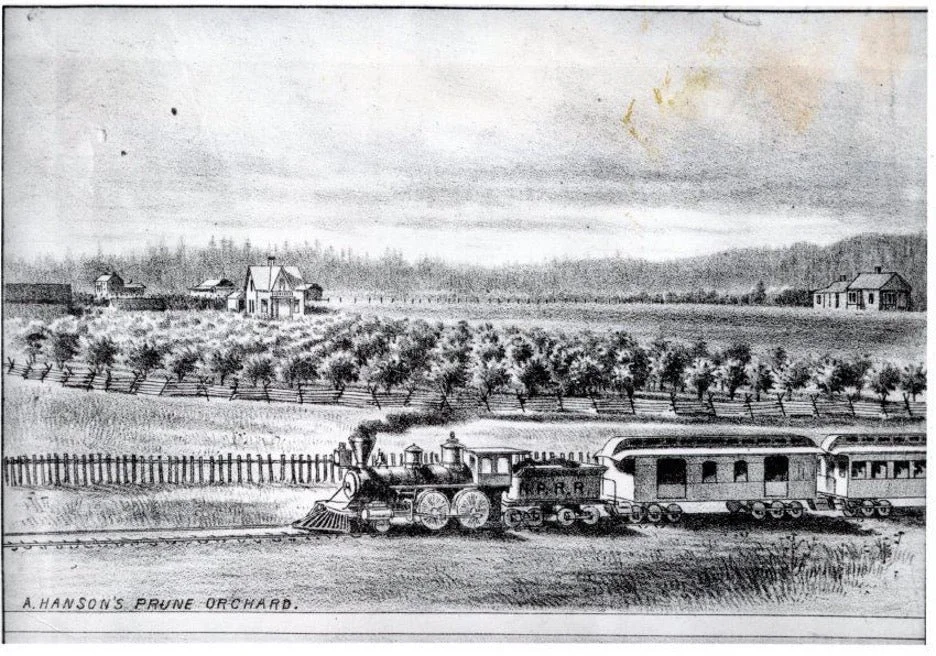
Henry and Nancy Hanson purchased the property between the two parts of town, built a home, and planted 400 Italian prune trees, 100 Petite D’Agen and Silver prunes, some Yellow egg and Peach plums, Strawberry apples, Bartlett pears, and English gooseberry currents. Newspapers touted the prune orchard as one of the finest in Western Washington.
Pressure was put on the Hansons to sell, so the two parts of the city could be connected. They didn’t want to sell, but eventually they developed the four blocks between Maple and Hanson Street and between the railroad and Pearl Street. When the Hansons platted the property (platting is subdividing into lots and registering the survey with the county, which was done on July 22 1889), they extended Tower Avenue from Washington’s section to the Railroad Addition section. Perhaps this is why they named one street Center Street. Excitement was so high for Tower Avenue’s extension in May 1889, that the grand opening was scheduled before all the stumps were removed from the street!
Henry and Nancy had moved to Centerville in 1881 from La Conner, where he had been a harness maker, and he was a harness maker when he first moved to Centerville. They were devout Baptists, and along with Washington, donated $1,000 to build Grace Seminary on Seminary Hill in March of 1889 making him and Washington the biggest private donors and securing the seminary for Centralia.
After their son Charles died in 1896, Henry and Nancy became spiritualists. They would make business decisions by consulting Henry's dead brother, who they reached through talking to his photograph. About the time Henry died in 1905, Nancy had a stroke and was partially paralyzed the last part of her life. When she died in 1910, she left all of her money to her grandchildren. Her last living son contested the will, saying she was not in her right mind. The case made case law by stating that “belief in spiritualism or any other religion is no evidence of insanity.”
The Hubbub Property (505 N Tower)
A surprising number, for the time period, of women owned the 505 N Tower property. Some outlived their spouses, but besides Josephine Townsend, two others purchased the property on their own even though married.
Jennie Wiard, wife of local druggist H. D. Wiard, bought the lot in 1890 for $300 from the Hansons. She unfortunately lost it to tax foreclosure in 1902. A few months later, Mary Hager Waunch Sawall, the remarried widow of the area’s first settler, George Waunch, bought 12 lots at auction from the county for $119.50, including 505 N Tower.
Sawall paid $200 to Wiard in 1908 for the property. She probably was under no legal obligation to do so; it appears she was just being kind.
Sawall sold the property to H. J. Miller, realtor, who bought up most of the block, calling it the “Miller Block.”
A small building existed on the lot in the early 1900s.
The 505 North Tower building was built in 1910 and its first known occupant was the Golden Rule Store. The Golden Rule Store was part of a chain and sold ladies and men's furnishings, which included clothing and possibly included furniture, decor, kitchenware and linens, which strikingly has overlap with Hubbub’s merchandise.
In April of 1911, the 505 building became the Freeman Grocery Store, selling a wide variety of goods, including produce and groceries, china, cooking pots, seeds, coffee, and coal. Brothers Edward, Arthur, and Truman Freeman ran the store. The store extended credit to its customers. Freeman’s Grocery employed an automobile delivery system to deliver groceries to all parts of the city.
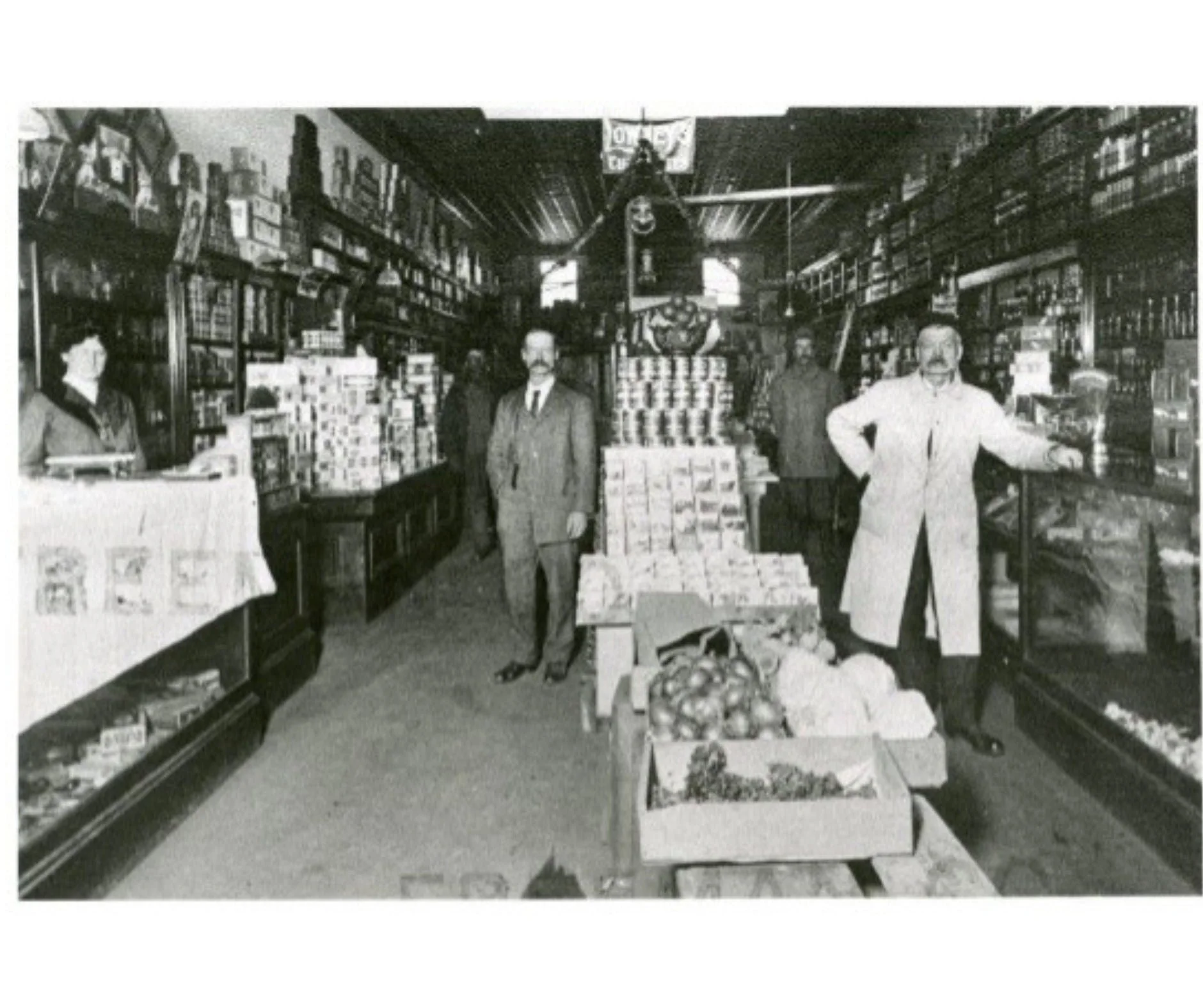
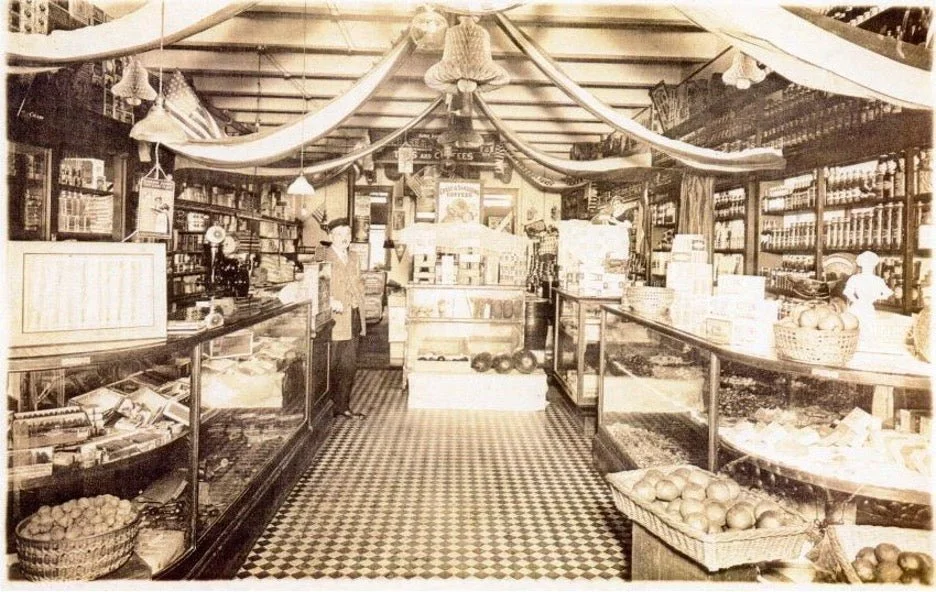
In 1916 Tony Aiello operated the Little Country Grocery Store with his uncle and aunt Mr. and Mrs. Louis Sonny, selling groceries, fruits, and vegetables. The store offered a car for hire to help customers get their groceries home. Aiello and the Sonnys were born in Sicily. Despite not yet being a full citizen (at that time it was a two-part process), when Aiello operated the Little Country Grocery Store, he joined the US Army serving a year as a First Sergeant with the 26th Engineers supplying advance troops with water in France during WWI.
By 1922 the 505 building had become a dry cleaners called French Dye Works, operated by Charles A. Prestel, the son of a civil war union veteran and father of G.K. Prestel, the second in command under Captain Kresky at the National Guard Armory across the street. French dye was the original name for dry cleaning. Centralians could freshen up their wardrobe at the French Dye Works with repairing, dyeing, and dry cleaning garments. Later, Prestel renamed his dry cleaning shop Prestel’s French Cleaners. In 1931 a new operator named his store Habit Cleaners.
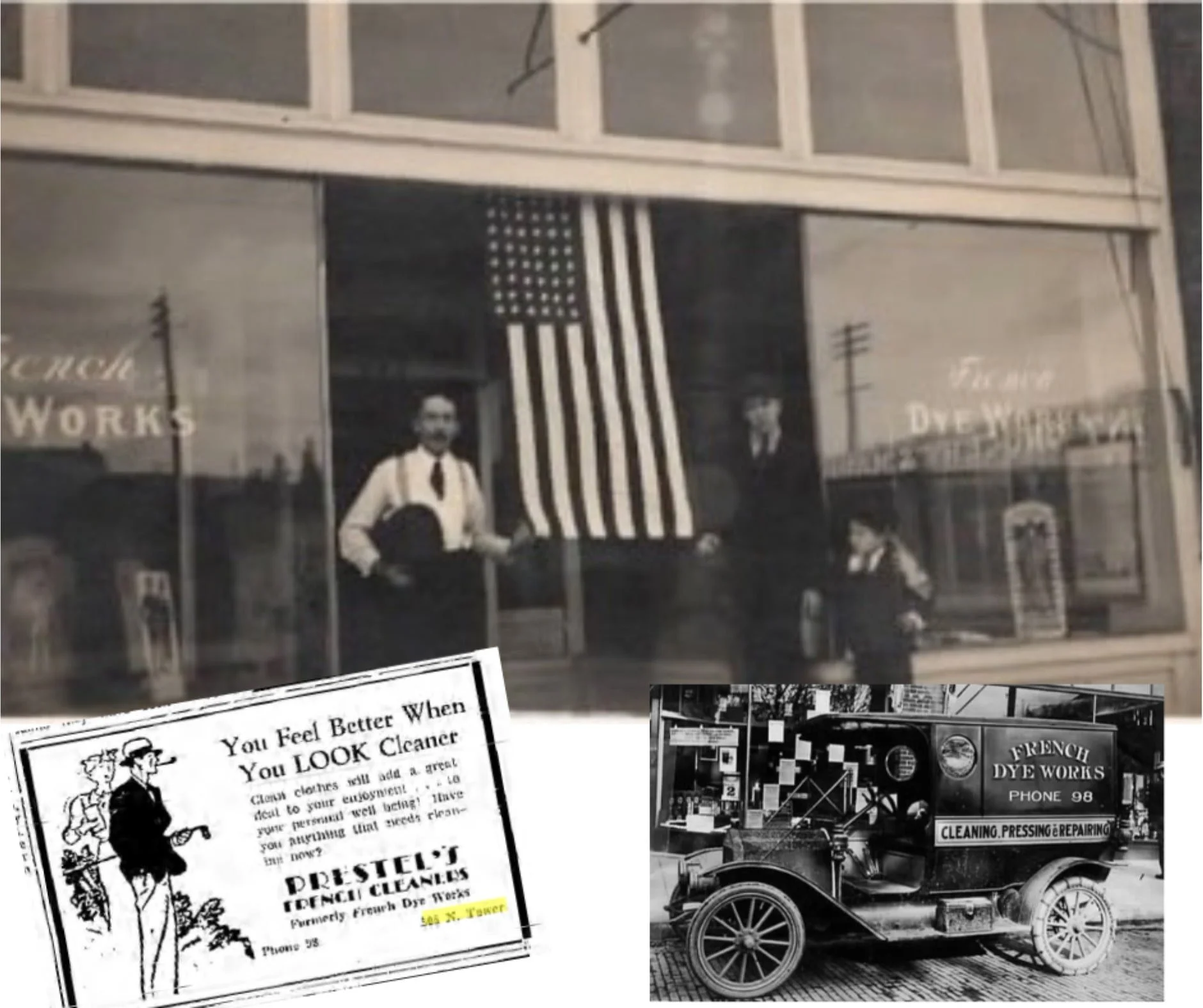
From 1943 to 1983, Alvah “Slim” and Maud Bennett ran the cleaners as Hub City Cleaners. The Bennetts were successful enough to buy the building in 1950. Maude died in 1981 and Slim died in 1983. Their children sold the property to Al and Teri Bonagofski.
For a short time period in 1987, a second-hand store called “Garage Sale” operated on the premises.
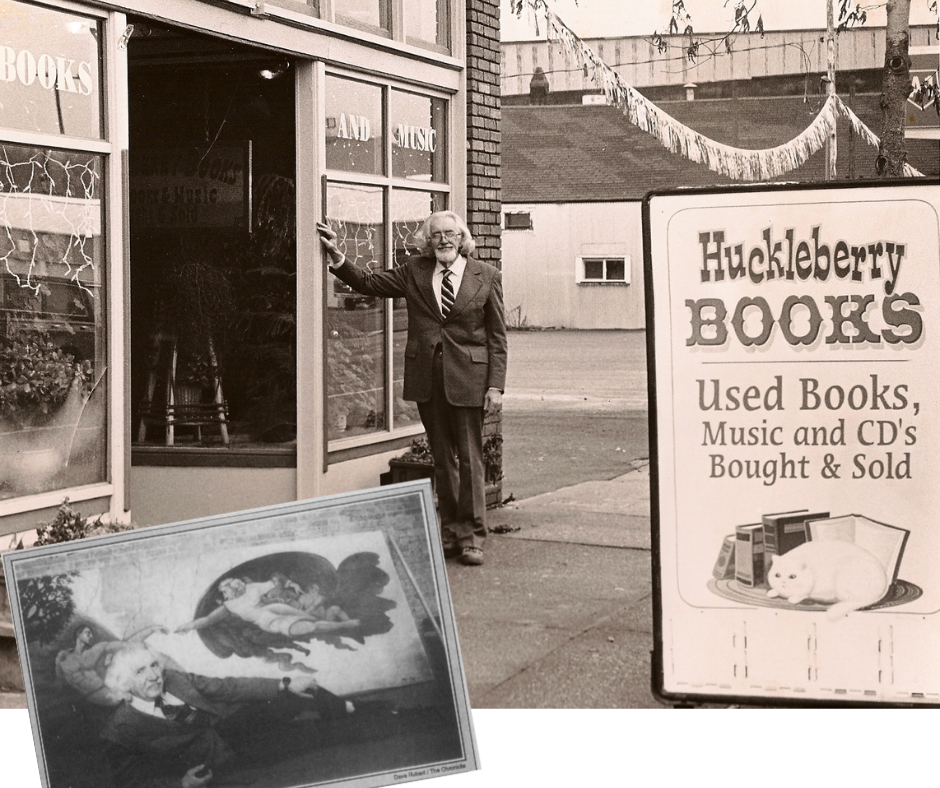
After 90 years hosting clothes and food related stores, the 505 North Tower building became a used bookstore in 1994 when Bill Moeller, an entertainer and public servant, opened Huckleberry Books. Moeller was mayor of Centralia in 1980 and served three terms on the city council. As mayor, he signed the ordinance creating Seminary Hill Natural Area. Moeller served five years in the US Army, beginning in 1946. His military career included armed forces radio host in Japan, paratrooper, and combatant in Korea.
Moeller spruced up the façade, interior, and living quarters in the rear of the building. He exposed the original brick walls and replaced a skylight with a painting mimicking Michaelangelo’s Sistine Chapel, though adding himself to the scene. Moeller also had rocking chairs around a wood stove for visitors to sit and chat (and pet the shop cat!). He sold the building to Sterling Pearson in 2001; Pearson operated a second-hand store in the space until the end of 2004.
Hubcap Art Park Property (501 and 503 N Tower)
In 1890 Henry and Nancy Hanson sold the Hubcap Art Park property, plus another lot, to Frank H. Miller for $2,000. Miller came to Centralia with Colonel George Ellsbury as secretary and purchasing Agent of the Tacoma, Olympia, and Chehalis Valley Railroad. He was later Centralia mayor.
In 1908 William Camby bought the property and erected the Camby building, a two story frame building, at a cost of $9,000. He operated the Columbia Hotel at 501 North Tower and rented the 503 North Tower side of the building.
In 1909 a large blue sign advertised the Bell Clothing Company at the 503 address. Just a few months later during its closing sale in July of 1909, the Bell Clothing Company offered free railroad fare to all out-of-town purchases of $25 or more for a radius of 30 miles, similar to when a company provides free shipping on large sales today.
Next Walter Brothers clothing store rented the store to sell men's clothing. In the 1920s it became Robert Brown Clothing.
In 1913, Camby sold the Camby building/Columbia Hotel to Mr. and Mrs. Joseph H. Bowen, who had managed the Rainier-Grand Hotel for the previous three years. Bowen operated the Columbia hotel until 1946. Lucinda Jones, later Lucinda Thurman, owned the hotel until 1959.
The Columbia Hotel featured at least 21 rooms with guests from as near as Napavine and as far as Milwaukee. The Columbia Hotel was also a polling place for District 7 in the 1930s. Either long term guests operated businesses out of their hotel room or the downstairs was rented as offices. Lew Gong practiced Chinese medicine on Wednesdays and Saturdays, and Vernon Ratcliffe ran a realtor's office from the hotel. In one ad, Ratcliffe offered to trade a 1920s Dodge touring car for a modern bungalow!
After selling the Columbia hotel, Camby ran for a city commissionership in 1915.
The 503 North Tower space was rented by St Vincent de Paul, a salvage bureau, in the 1940s and the Salvation Army in the 1950s and 1960s.
The Camby Building came down in 1972.
Today
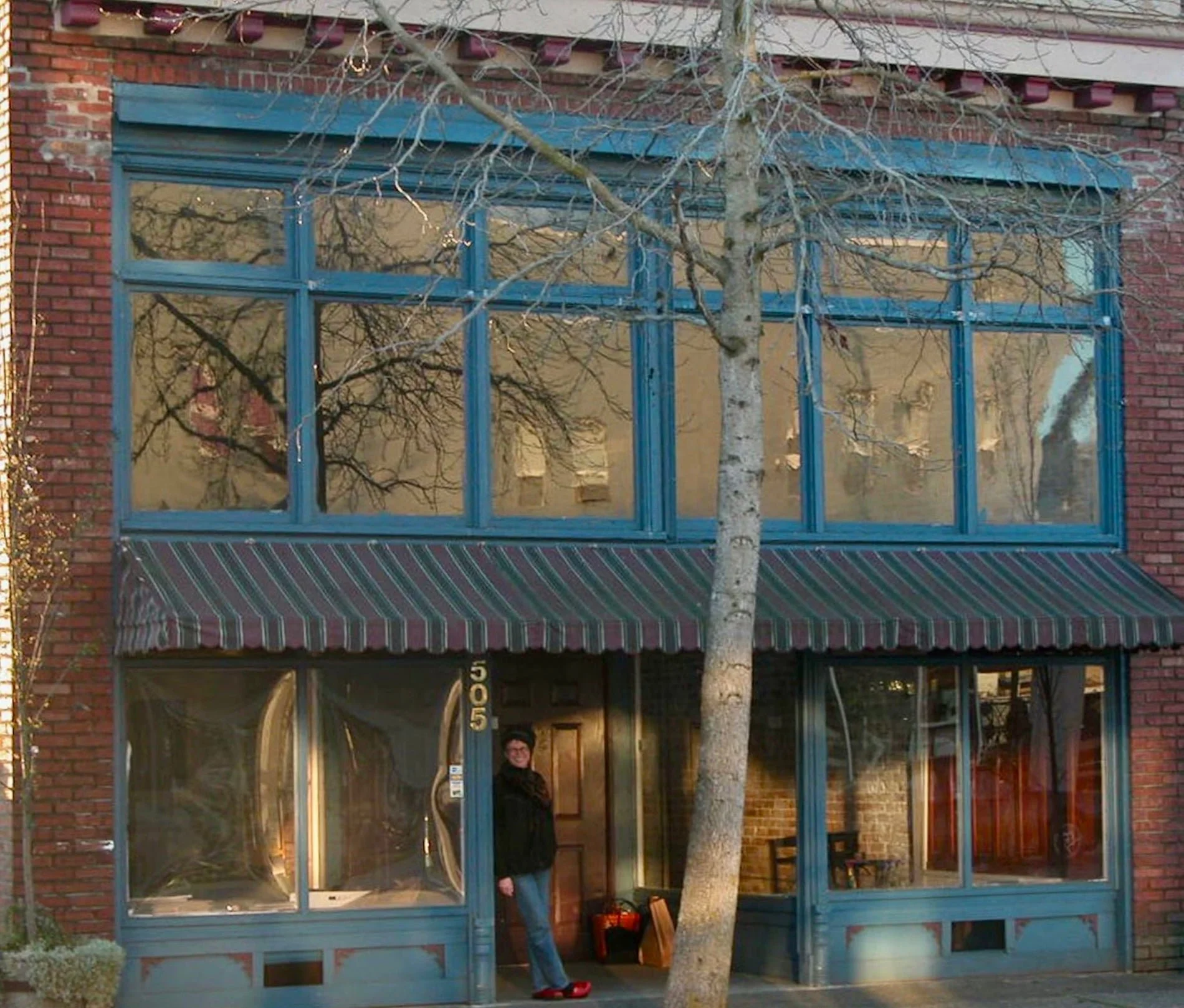
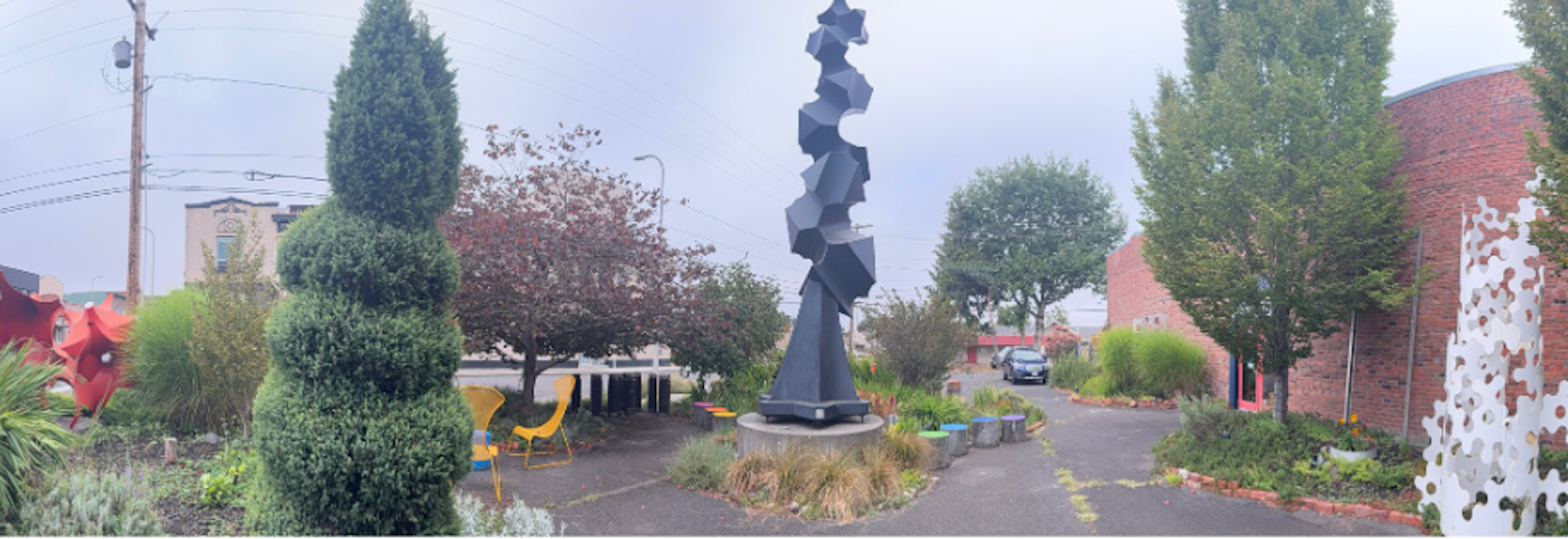
Rebecca Staebler bought the building in 2005 and opened Hubbub, the present shop. Hubbub quickly became a favorite place to shop for both locals and tourists. Hubbub sells art with a purpose, including clothes, jewelry, décor, gifts, and cards, or to use the old-fashioned term used by the first shop – ladies furnishings. In 2008, Staebler bought the two lots where the Columbia Hotel had stood. Like George Washington, Staebler created a space for the public to enjoy. She filled the park with art, flowers, and benches for contemplation and called it Hubcap. (Hub City Art Park)
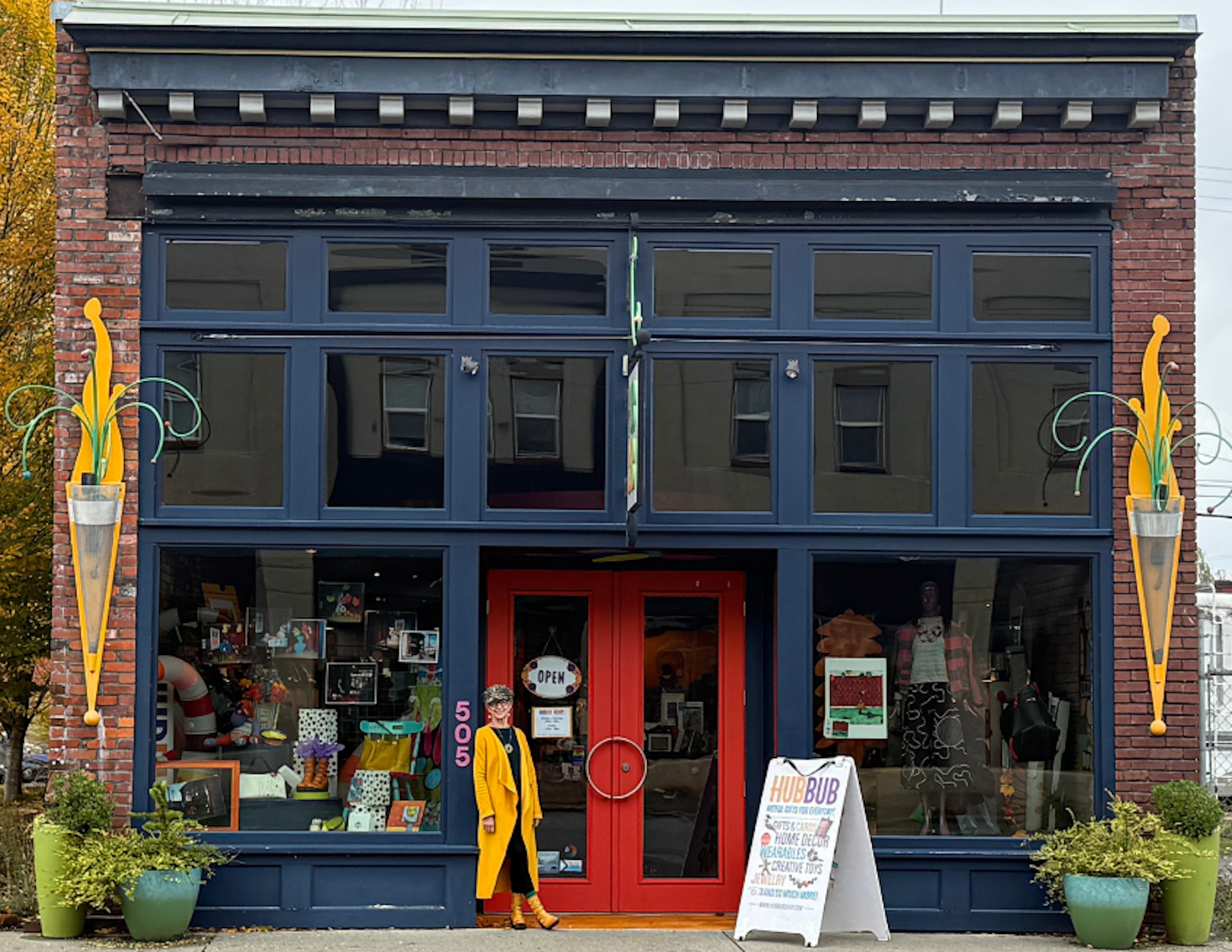
The 505 N Tower Building survived 107 years intact until on May 6th, 2017, a drunk driver crashed into the corner of the building destroying part of the exterior brick and half the plate glass windows. The driver was flown to Harborview with serious injuries. Insurance company negotiations took years to complete.
Like many of the former owners of the property, Staebler is part of city government as a city councilmember. She also volunteers in Art Trails, the Fox Theater restoration, and previously the Centralia Historic District and the Committee to celebrate the 200th birthday of the town founder – George Washington – the first owner of the property.